Cultural aspects

Gender differentiationedit

A group of women and men gathered at sport event in Sweden (1938).

3rd Duke of Fife wearing a traditional Scottish kilt (1984).

A Hindu North Indian wedding, with the groom wearing a sherwani and pagri turban, while the bride in a sari.

Advisor to US President and businesswoman Ivanka Trump (right) along with Japanese PM Shinzō Abe wearing Western-style business suits as per their gender, 2017.

Red carpet fashion: Italian actors Gabriel Garko and Laura Torrisi wearing designer dress code, 2009. The man is in suit and the woman is wearing a gown.


In most cultures, gender differentiation of clothing is considered appropriate. The differences are in styles, colors, fabrics, and types.
In Western societies, skirts, dresses, and high-heeled shoes are usually seen as women's clothing, while neckties are usually seen as men's clothing. Trousers were once seen as exclusively men's clothing, but can nowadays be worn by both genders. Men's clothes are often more practical (that is, they can function well under a wide variety of situations), but a wider range of clothing styles are available for women. Men are typically allowed to bare their chests in a greater variety of public places. It is generally common for a woman to wear clothing perceived as masculine, while the opposite is seen as unusual.
In some cultures, sumptuary laws regulate what men and women are required to wear. Islam requires women to wear more modest forms of attire, usually hijab. What qualifies as "modest" varies in different Muslim societies; however, women are usually required to cover more of their bodies than men. Articles of clothing Muslim women wear for modesty range from the head-scarf to the burqa.
Men may sometimes choose to wear men's skirts such as togas or kilts in particular cultures, especially on ceremonial occasions. Such garments were (in previous times) often worn as normal daily clothing by men.
Clothing designed to be worn by either sex is called unisex clothing. Unisex clothes, such as T-shirts, tend to be cut straighter to fit a wider variety of bodies. The majority of unisex clothing styles have started out as menswear, but some articles, like the fedora, were originally worn by women.
Social statusedit

Achkan sherwani and churidar (lower body) worn by Arvind Singh Mewar and his kin during a Hindu wedding in Rajasthan, India. Traditionally, these clothes were worn by the elites of the Indian subcontinent.
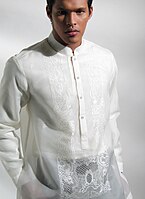
A Barong Tagalog made for a wedding ceremony.
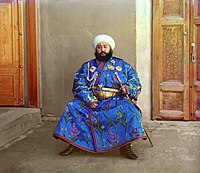
Alim Khan's bemedaled robe sends a social message about his wealth, status, and power.

In some societies, clothing may be used to indicate rank or status. In ancient Rome, for example, only senators could wear garments dyed with Tyrian purple. In traditional Hawaiian society, only high-ranking chiefs could wear feather cloaks and palaoa, or carved whale teeth. In China, before establishment of the republic, only the emperor could wear yellow. History provides many examples of elaborate sumptuary laws that regulated what people could wear. In societies without such laws, which includes most modern societies, social status is instead signaled by the purchase of rare or luxury items that are limited by cost to those with wealth or status. In addition, peer pressure influences clothing choice.
Religionedit

The Buddha wearing kāṣāya robes. Originating from ancient India, these robes were worn by fully ordained Buddhist monks and nuns.

Muslim men traditionally wear white robes and a cap during prayers.
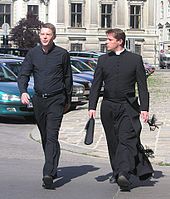
Clerical clothing worn by Catholic priests.


Some religious clothing might be considered a special case of occupational clothing. Sometimes it is worn only during the performance of religious ceremonies. However, it may also be worn every day as a marker for special religious status.
For example, Jains and Muslim men wear unstitched cloth pieces when performing religious ceremonies. The unstitched cloth signifies unified and complete devotion to the task at hand, with no digression.citation needed Sikhs wear a turban as it is a part of their religion.
The cleanliness of religious dresses in some religions such as Hinduism, Sikhism, Buddhism, Islam and Jainism is of paramount importance since it indicates purity.
Clothing appears in numerous contexts in the Bible; the most prominent passages are: the story of Adam and Eve who made coverings for themselves out of fig leaves, Joseph's cloak, Judah and Tamar, Mordecai and Esther. Furthermore, the priests officiating in the Temple in Jerusalem had very specific garments, the lack of which made one liable to death.
The Quran says about husbands and wives, regarding clothing: "...They are clothing/covering (Libaas) for you; and you for them" (chapter 2:187).
Jewish ritual also requires rending of one's upper garment as a sign of mourning.further explanation needed
Christian clergy members wear religious vestments during liturgical services and may wear specific non-liturgical clothing at other times.


Comments
Post a Comment