Origin and history
Early useedit
Scientists are still debating when people started wearing clothes. Estimates by various experts have ranged from 40,000 to 3 million years ago. Some more recent studies involving the evolution of body lice have implied a more recent development with some indicating a development of around 170,000 years ago and others indicating as little as 40,000. No single estimate is widely accepted.
Ralf Kittler, Manfred Kayser and Mark Stoneking, anthropologists at the Max Planck Institute for Evolutionary Anthropology, conducted a genetic analysis of human body lice that suggests clothing originated around 170,000 years ago. Body lice are an indicator of clothes-wearing, since most humans have sparse body hair, and lice thus require human clothing to survive. Their research suggests that the invention of clothing may have coincided with the northward migration of modern Homo sapiens away from the warm climate of Africa, thought to have begun between 50,000 and 100,000 years ago. However, a second group of researchers using similar genetic methods estimate that clothing originated around 540,000 years ago.
According to archaeologists and anthropologists, the earliest clothing likely consisted of fur, leather, leaves, or grass that were draped, wrapped, or tied around the body. Knowledge of such clothing remains inferential, since clothing materials deteriorate quickly compared to stone, bone, shell and metal artifacts. Archeologists have identified very early sewing needles of bone and ivory from about 30,000 BC, found near Kostenki, Russia in 1988. Dyed flax fibers that could have been used in clothing have been found in a prehistoric cave in the Republic of Georgia that date back to 34,000 BC.
Making clothingedit
Some human cultures, such as the various peoples of the Arctic Circle, traditionally make their clothing entirely of prepared and decorated furs and skins. Other cultures supplemented or replaced leather and skins with cloth: woven, knitted, or twined from various animal and vegetable fibers including wool, linen, cotton, silk, hemp, and ramie.
Although modern consumers may take the production of clothing for granted, making fabric by hand is a tedious and labor-intensive process involving fiber making, spinning, and weaving. The textile industry was the first to be mechanized – with the powered loom – during the Industrial Revolution.
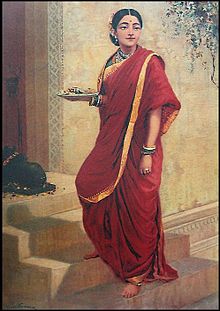
Different cultures have evolved various ways of creating clothes out of cloth. One approach simply involves draping the cloth. Many people wore, and still wear, garments consisting of rectangles of cloth wrapped to fit – for example, the dhoti for men and the sari for women in the Indian subcontinent, the Scottish kilt and the Javanese sarong. The clothes may simply be tied up (dhoti and sari); or pins or belts hold the garments in place (kilt and sarong). The cloth remains uncut, and people of various sizes can wear the garment.
Another approach involves measuring, cutting, and sewing the cloth by hand or with a sewing machine. Clothing can be cut from a sewing pattern and adjusted by a tailor to the wearer's measurements. An adjustable sewing mannequin or dress form is used to create form-fitting clothing. If the fabric is expensive, the tailor tries to use every bit of the cloth rectangle in constructing the clothing; perhaps cutting triangular pieces from one corner of the cloth, and adding them elsewhere as gussets. Traditional European patterns for men's shirts and women's chemises take this approach. These remnants can also be reused to make patchwork hats, vests, and skirts.
Modern European fashion treats cloth much less conservatively, typically cutting in such a way as to leave various odd-shaped cloth remnants. Industrial sewing operations sell these as waste; home sewers may turn them into quilts.
In the thousands of years that humans have been making clothing, they have created an astonishing array of styles, many of which have been reconstructed from surviving garments, photos, paintings, mosaics, etc., as well as from written descriptions. Costume history can inspire current fashion designers, as well as costumiers for plays, films, television, and historical reenactment.

Comments
Post a Comment